


Workplace Resources for Employers and Businesses
Workforce Essentials offers a wide variety of unique resources to help businesses and employers. We can assist with finding, screening, or retaining employees through services such as job fairs, WIOA business services, job postings, drug testing, background checks, on-the-job-training programs, OSHA training, customized training, and so much more. We are your one-stop business solution!

Employer FAQs
The Federal Motor Carrier Safety Administration (FMCSA) requires carriers and any employee with a commercial driver’s license (CDL) to be in a DOT random drug and alcohol testing pool.
Reasonable suspicion is a belief, based on specific and observable facts (such as appearance, behavior, speech, or body odors), that an employee is under the influence of drugs or alcohol. This is a common trigger for required testing under both DOT and TnDFWP policies.
While some states have legalized marijuana, it remains illegal in Tennessee. Employers in Tennessee, especially those in the Drug Free Workplace Program, generally have a zero-tolerance policy. A positive test for marijuana can be grounds for disciplinary action, including termination.
Yes. All CDL holders, including owner-operators with no employees, must be enrolled in a DOT random drug and alcohol testing pool. Owner-operators typically join a consortium to meet this requirement.
The DOT requires testing in six situations:
- Pre-employment
- Reasonable suspicion
- Post-accident
- Random
- Return-to-duty
- Follow-up
A standard DOT drug test screens for five classes of substances:
- Marijuana (THC)
- Cocaine
- Amphetamines (including methamphetamine, MDMA)
- Opioids (including codeine, morphine, heroin, oxycodone, hydrocodone)
- Phencyclidine (PCP)
The FMCSA sets annual random testing rates for the entire industry. For 2024, the rates are 50% for drug testing and 10% for alcohol testing.
The FMCSA Drug & Alcohol Clearinghouse is a secure online database that gives employers and other authorized users real-time information about CDL drivers’ drug and alcohol program violations. Employers are required to query the Clearinghouse for all new hires and conduct annual queries for all existing drivers.
DOT post-accident testing is required as soon as possible after an accident in the following situations:
- There was a fatality; OR
- The driver was cited for a moving violation, AND the accident involved either:
- Bodily injury to any person who receives medical treatment away from the scene.
- One or more vehicles incurred disabling damage and were towed from the scene.
An MRO is a licensed physician who is responsible for reviewing laboratory-confirmed positive drug test results. The MRO will interview the donor to determine if there is a legitimate medical explanation (like a prescription) for the result before reporting it to the employer.
If you have a commercial drivers license (CDL) then you are required to be in a DOT random drug and alcohol testing pool.
DOT has a very strict definition of when a post-accident test is required. Post-accident testing on the driver must be completed as soon as possible following an accident where:
- There was a fatality and/or
- The driver was cited for a moving violation.
If the driver was issued a citation, the following must also involve:
- Bodily injury to any person who receives medical treatment away from the scene of the accident or
- One or more vehicles incurring disabling damage to be towed away from the scene of the accident.
Post-accident alcohol testing should be done within 8 hours of the accident. If testing cannot be done within the time limit, the employer must maintain a file that explains why the testing was not done.
Post-accident drug testing should be done within 32 hours of the accident. If the testing cannot be done within the time limits, the employer should cease attempts to conduct post-accident tests. The employer should maintain on file that explains why the post-accident test was not performed.
The Federal Motor Carriers Safety Administration (FMCSA) requires random drug testing at 50% annually and random alcohol testing at 10% annually. Other DOT agencies may require different percentages of random testing.
Pre-employment, post-accident, reasonable suspicion, and random testing are required. In addition, return-to-work and follow-up testing may be required under certain circumstances.
Workforce Essentials offers several types of tests, including:
- Quick tests: Instant-result devices like dip cards or cups.
- Lab-based urine drug tests: Specimens are sent to a certified lab for screening and, if necessary, confirmation by a Medical Review Officer (MRO).
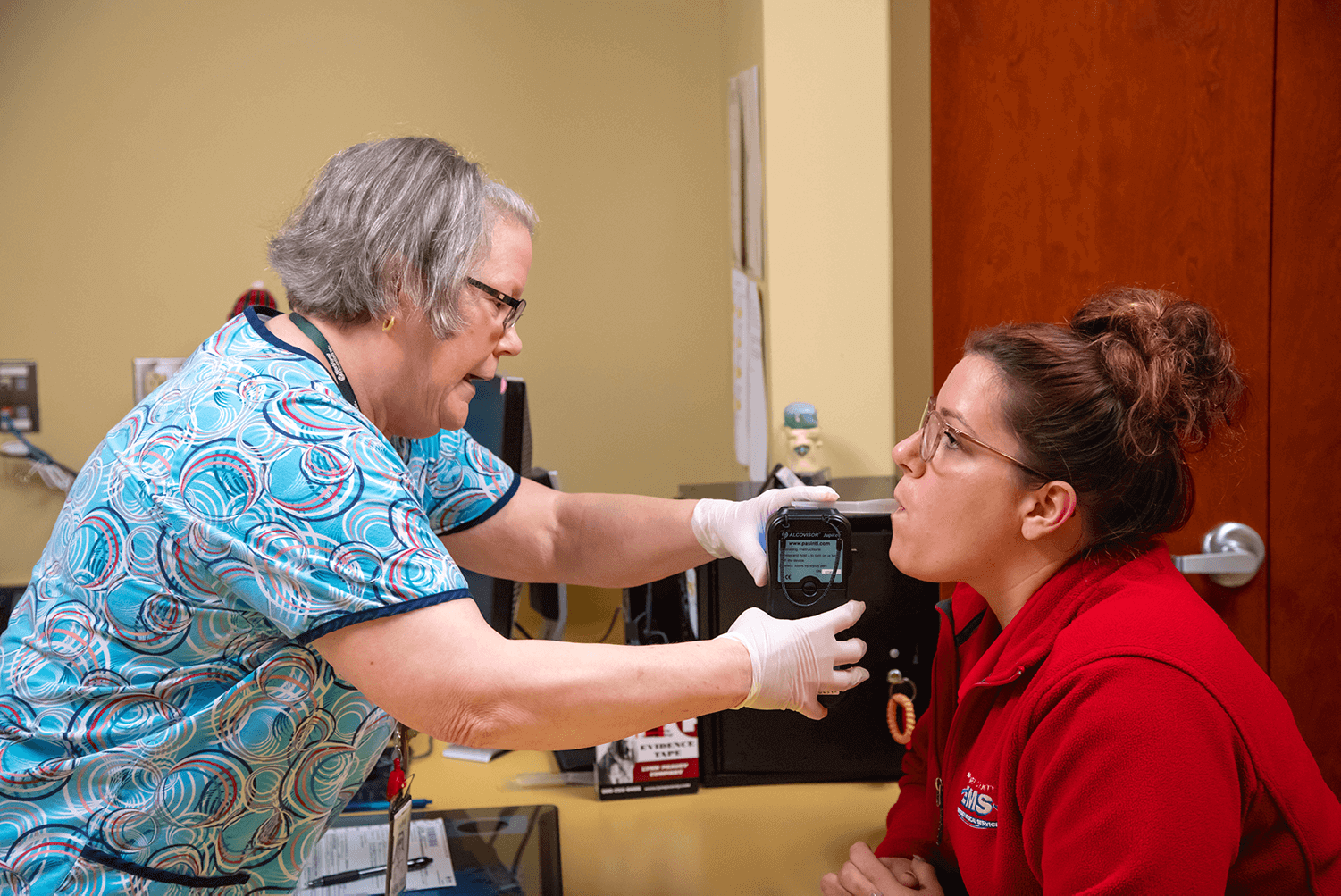
- Breath Alcohol Tests (BAT): Provide immediate results for alcohol.
- Hair tests: Sent to a lab for analysis.
It depends on the type of test taken AND the test result. For a quick test, results are instantaneous. Lab-based urine drug tests results usually take about 24 hours if negative. Hair tests results take approximately 5 working days.
Yes, but a parent or guardian must sign an affidavit.
Key benefits for participating employers include:
- A 5% premium credit on their workers’ compensation insurance policy.
- Legal protection is denied for workers’ compensation claims if an employee tests positive after an injury.
- Disciplinary action for a positive test is considered to be “for cause”.
This is at the employer’s discretion. An employer may terminate the employee. However, if the employer chooses, they can retain the employee, but only if the employee agrees to see a substance abuse professional (SAP), completes the recommended treatment, and passes a return-to-work drug test.
No, all specimens for the TnDFWP must be tested by a certified laboratory. Quick tests are not permitted for this program.
Testing is required after an accident that results in an injury for which the employee receives medical treatment. A drug test must be done within 32 hours, and an alcohol test (if necessary) within 8 hours.
No, random testing is optional under this program. If an employer decides to implement random testing, they can determine the quantity and frequency.
No, existing employees are not required to be tested just for implementing the program (they are “grandfathered” in). However, employers have the right to test all employees as part of their policy, especially for reasonable suspicion or post-accident.
No, a formal Employee Assistance Program (EAP) is not required. However, you must maintain and provide a list of local substance abuse treatment providers to any employee who tests positive or requests help.
No, but you must maintain a list of providers that you can make available to any employee that is seeking help or tests positive.
An established program capable of providing expert assessment of employee personal concerns; confidential and timely identification services with regard to employee drug or alcohol abuse; referrals of employees for appropriate diagnosis, treatment and assistance; and follow-up services for employees who participate in the program or require monitoring after returning to work. An EAP may also provide treatment services.
No, the employer must pay the cost of all tests required by the employer.
Yes, but only if they agree to see a substance abuse professional (SAP), receive treatment, and pass a return to work drug test. Additionally, the employee must be subject to random testing for a period of time at the discretion of the SAP. Employers may also decide to terminate the employee upon receipt of a positive drug test.
This depends on the test type and the result.
- Quick test: Results are instantaneous.
- Lab-based urine drug test: Negative results usually take about 24 hours. A positive result may take several days for confirmation and MRO review.
- Hair test: Results take approximately 5 working days.
No, all specimens must be tested by a certified laboratory.
After an accident which results in an injury and only after the employee receives medical treatment if it is required. If an injury is reported after the fact, the injured employee must submit to testing at the time the injury is entered into the employer’s OSHA Log. A drug test must be done within 32 hours of the accident and an alcohol test (if necessary) within 8 hours of the accident.
No, random testing is optional under the TnDFWP. If an employer decides to implement random testing, the employer can determine the quantity and frequency of the random selections.
No, existing employees are ‘grandfathered’ into the program. However, employers reserve the right to test all employees if they wish to do so.